research
the group's three main lines of research, each with its people, software and key papers. Jump to a topic: ringdowns · populations · methods.
Black-hole ringdowns
Listening to the final ring of newborn black holes to test general relativity and the Kerr nature of black holes.
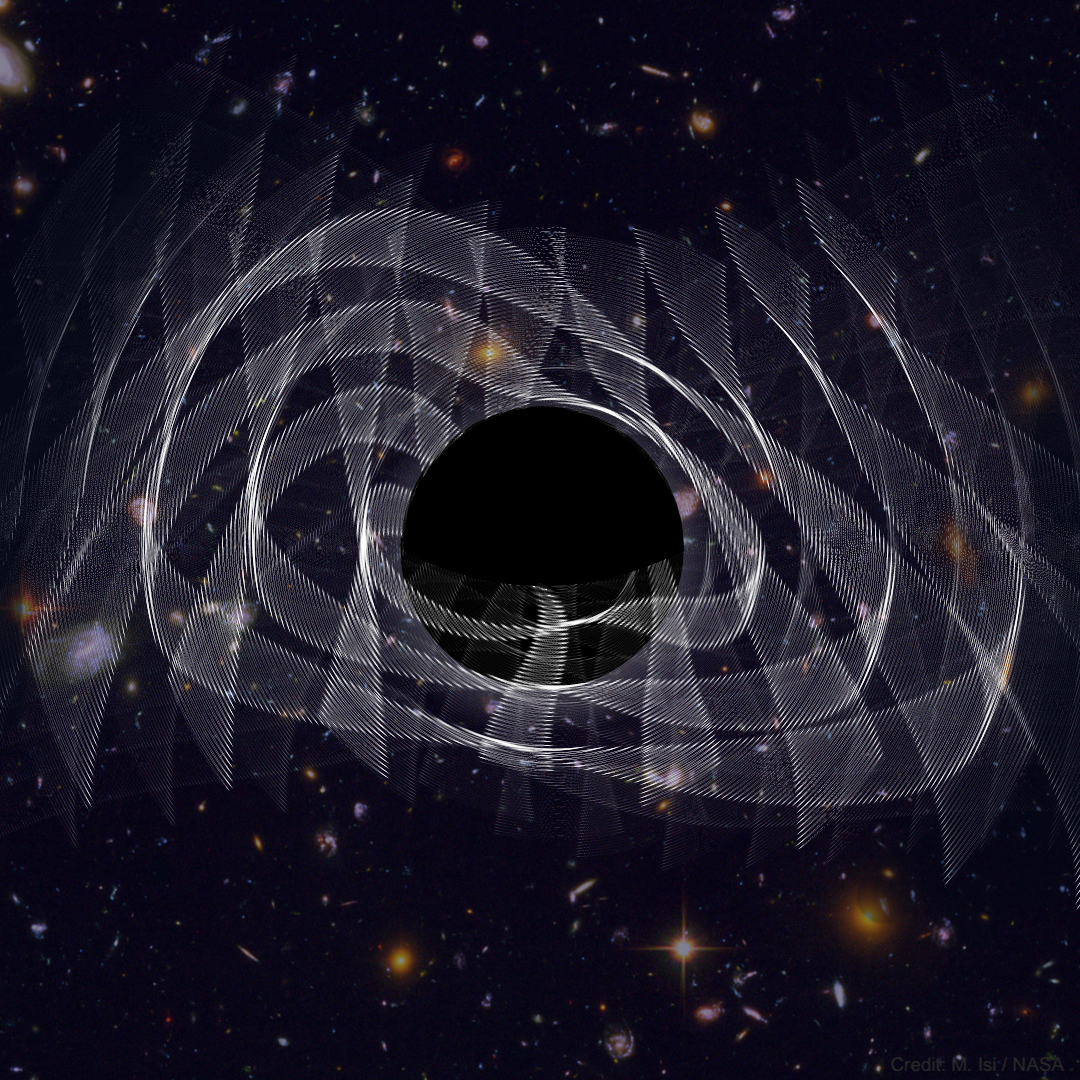
When two black holes merge, the remnant is born highly distorted and settles down by emitting gravitational waves at a discrete set of frequencies and damping times: its quasinormal modes. General relativity predicts that, for a Kerr black hole, the whole spectrum is fixed by just the mass and spin. Measuring two or more modes in the same signal therefore turns each merger into a laboratory for the no-hair theorem and for the nature of black holes, an idea known as black-hole spectroscopy.
Our group has been at the forefront of turning this idea into a reality. Starting with GW150914, we have shown that overtones bring black-hole spectroscopy within reach of LIGO and Virgo. This was most strikingly demonstrated with GW250114, a record-loud signal whose ringdown furnished the best tests yet of the Kerr nature of black holes and of Hawking’s black-hole area law. Our group’s work made these results possible by developing a self-consistent framework for analyzing ringdowns directly in the time domain and producing widely-used software to do so. We have also quantified the systematics that may arise from detector noise and data conditioning, and applied these tools to the most massive events observed by LIGO and Virgo, including GW190521 and GW231123, where hints of multiple modes and precessional signatures appear.
Ongoing work connects the observations to numerical relativity, including nonlinear and precessing ringdowns, the polarization content of the ringdown signal, and forecasts for what next-generation detectors and LISA will be able to say about the black holes they observe. These analyses are carried out with our open-source ringdown package.
Software
Key papers


Black-hole populations
What the growing catalog of mergers reveals about how black holes form, spin, and pair up, and what gravity looks like at the population level.
The LIGO–Virgo–KAGRA detectors have now observed hundreds of compact-binary mergers. Taken together, these events encode the astrophysics of how massive stars live and die, how binaries form in the field and in dense clusters, and how black holes acquire their masses and spins. We use hierarchical Bayesian inference to read that record off the catalog while accounting for measurement uncertainty and selection effects.
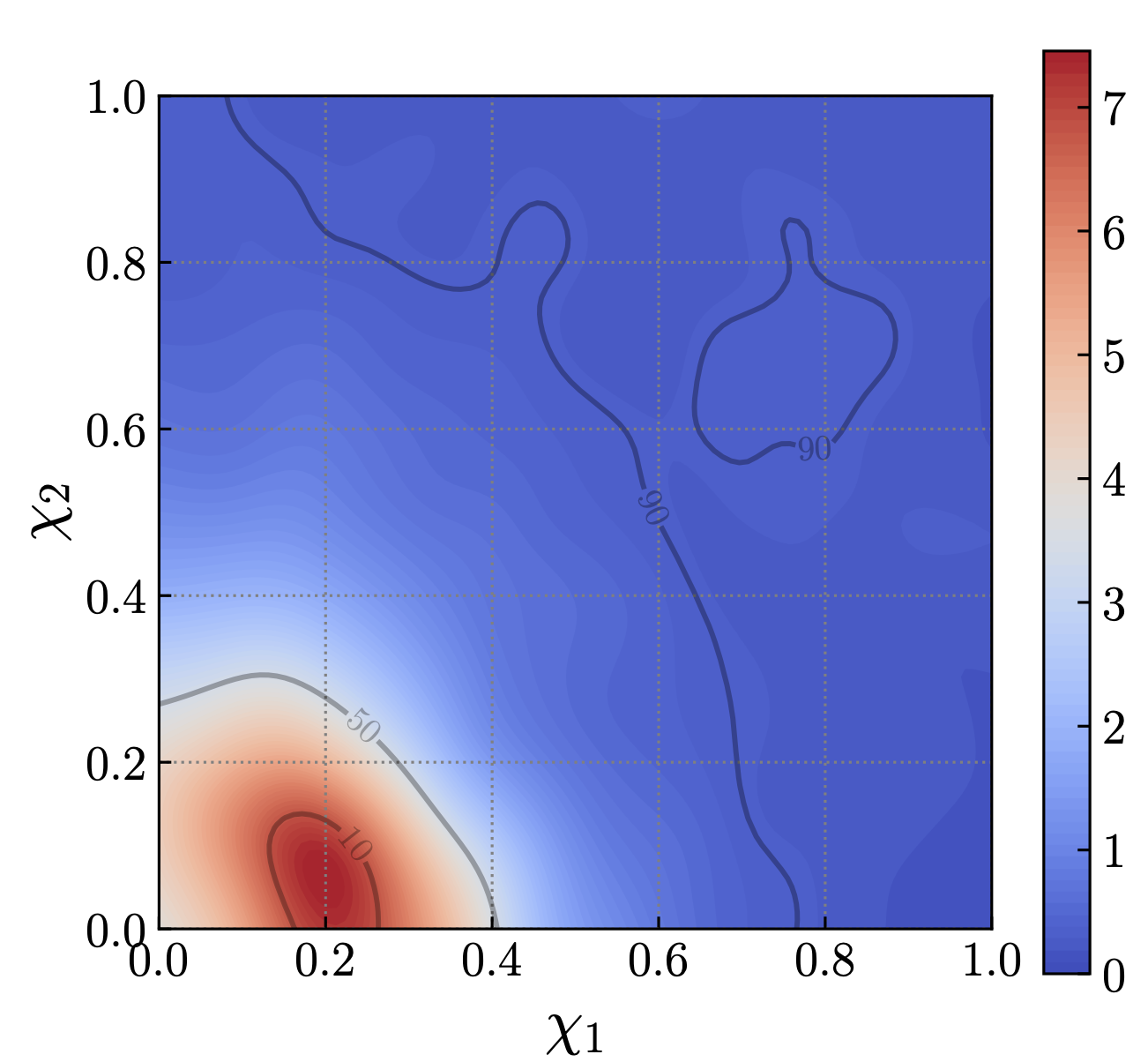
Much of our work focuses on spins: we developed methods to measure the spins and spin orientations of heavy binaries, found hints of spin–orbit resonances and of a rapidly spinning subpopulation of black holes, and studied how spin precession leaves its imprint on the most massive events. On the mass side, we build physically motivated models of the black-hole mass function to interpret features such as the bump near 35 solar masses, and we develop tests for structure at the edges of parameter space. We have also studied the directional isotropy of the observed binaries, gravitational recoil, and how mergers can be used as standard sirens.
The same hierarchical machinery lets us test general relativity with the population as a whole, combining many events into a single, robust statement about deviations from Einstein’s theory, and it powers searches for subtle effects such as gravitational-wave memory.
Key papers


Machine learning and statistical methods
Fast, flexible inference tools: differentiable waveforms, normalizing flows, and likelihoods that learn what real detector noise looks like.
Extracting physics from gravitational-wave data is a problem in statistical inference, and the growing catalog demands tools that are both faster and more honest about the data than the standard approach. We develop such tools, drawing on modern machine learning and hardware-accelerated computing, and we release them as open-source software.
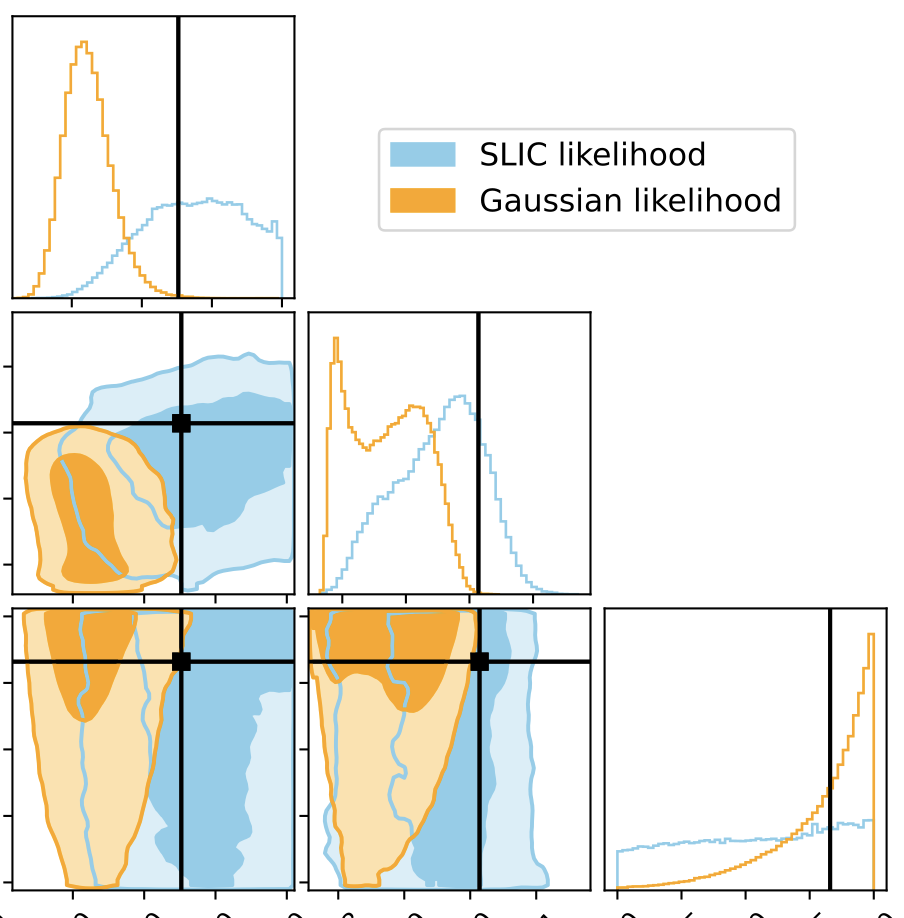
With collaborators we built jim, a parameter-estimation code that combines differentiable waveforms (ripple), normalizing flows, and GPU sampling to analyze a signal in minutes rather than days, without simplifying assumptions. We have used score-based generative models to characterize non-Gaussian detector noise directly from data and machine learning to remove nonstationary noise from the detectors, and we develop time-domain inference techniques that avoid the pitfalls of the usual frequency-domain likelihood.
The same emphasis on methodology runs through the rest of our research: hierarchical models for populations and for tests of general relativity, signal-coherence statistics for detection confidence, and careful treatments of noise estimation and data conditioning for ringdown analyses. Worked examples of many of these techniques are collected in our notes.